TiMi AI

Bitcoin is the foundation of the crypto market. Understanding the basics of Bitcoin and the most critical information is essential for anyone considering investing or trading digital assets.
Key insights:
- Bitcoin is the first decentralized currency based on blockchain technology, with a fixed supply of 21 million coins.
- It remains a benchmark for the crypto market, while altcoins also drive innovation and scalability.
- BTC has shown strong growth over the last couple of years, from $16,500 in early 2023 to over $120,000 in 2025.
- Bitcoin relies on Proof of Work, mining, and blockchain hashes for security and decentralization.
- Introduced in 2008 by Satoshi Nakamoto, Bitcoin evolved from an experiment into a leading global asset.
Bitcoin 101
Bitcoin (BTCUSD) is the first and most recognizable cryptocurrency—a decentralized, peer-to-peer digital currency powered by blockchain technology. Its unique approach of removing intermediaries and enabling secure, borderless transactions has revolutionized global finance.
What are the key facts about Bitcoin?
- Only 21 million BTC will ever exist. This limited supply drives demand in an unusual way (more about that below),
- As a blockchain-based asset, every transaction is recorded publicly, ensuring transparency and security.
- Compared to other assets, such as precious metals, Bitcoin is highly volatile.
- Bitcoin is usually the benchmark for the entire crypto market.
SimpleFX gives access to Bitcoin CFD (BTCUSD). It enables traders to enter the market in a flexible way.
Bitcoin vs Altcoins
There are thousands of cryptocurrencies other than Bitcoin—altcoins. Each of them has its own unique values.
The comparison between Bitcoin and two major altcoins – Ethereum (ETH) and Solana (SOL):
| Bitcoin | Ethereum | Solana | |
| Purpose | Digital money, store of value | Smart contracts and dApps | Scalable Web3 platform |
| Consensus mechanism | Proof of Work (PoW) | Proof of Stake (PoS) | Proof of History + PoS hybrid |
| Pros | Security, decentralization | Innovation, flexibility | Speed, low fees |
| Weaknesses | Energy-intensive (due to PoW mechanism) | Network congestion | Occasional network outrages |
Recent BTC performance
The data regarding the two previous years confirms the Bitcoin green trend. In 2023, BTCUSD started at $16,500 and finished the year above $42,000, for an over 150% increase in value. At the end of 2024, after the post-U.S. elections rally, Bitcoin reached over $93,000, earlier crossing the magical barrier of $100,000.
You can find out how it performs in 2025.
Q1 2025
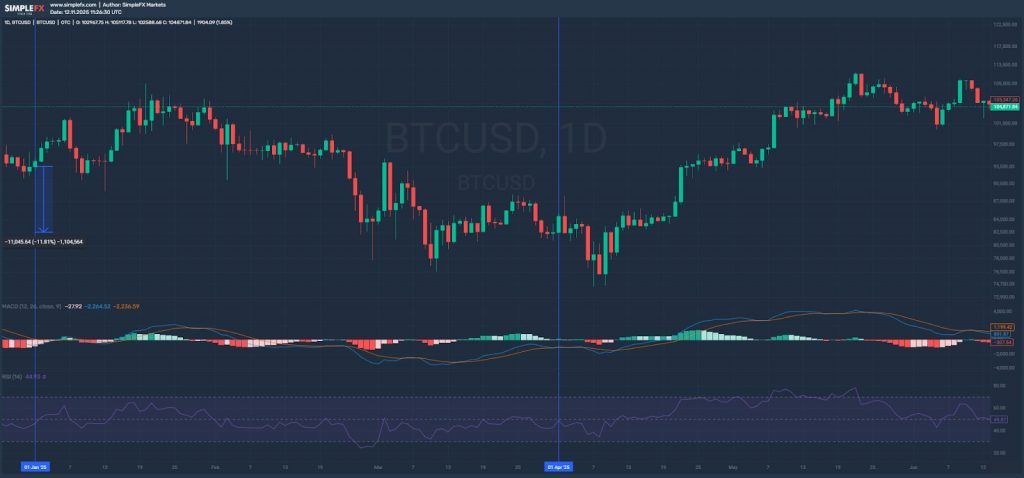
The first quarter of 2025 proved to be a rather disappointing period for BTC. Due to growing market concerns about high tariffs, the price fell by over 11% to ~$83,000.
Q2 2025
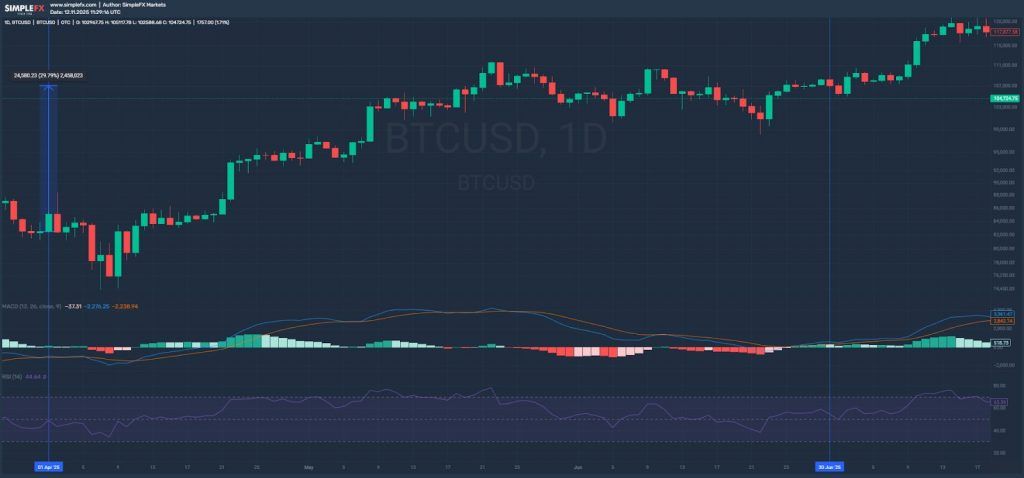
When it became clear that US tariffs wouldn’t be as high as previously thought, BTC began its spring rally. The mid-year closed around $104,000, representing a nearly 30% quarterly gain.
Q3 2025
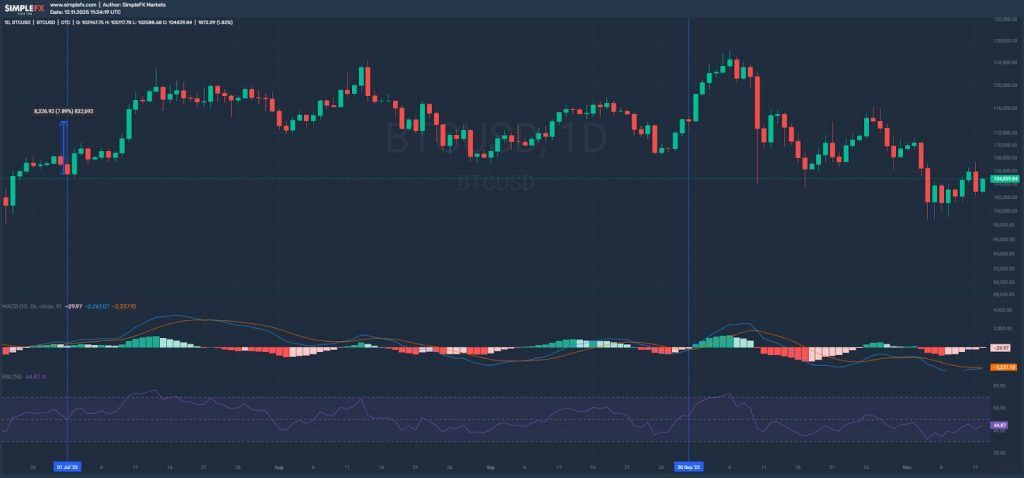
The third quarter saw BTC consolidate. The final close was near $114,000, with a modest 8% gain.
BTC mining
Bitcoin mining is the process by which transactions are validated. It involves computational power to solve complex cryptographic puzzles, allowing miners to secure the network and earn newly created bitcoins as a reward.
How difficult is Bitcoin mining?
Bitcoin mining difficulty adjusts roughly every two weeks (every 2016 blocks) to ensure that new blocks are created about every 10 minutes, regardless of how many miners are participating. When more miners join the network and total computational power (hash rate) increases, the difficulty rises; when miners leave, it decreases.
How does Bitcoin mining impact the halving process?
According to the Bitcoin whitepaper, mining rewards are halved every 210,000 blocks. It means that approximately every 4 years, the mining reward and BTC inflation halve.
How much energy does it require?
Miners worldwide compete to solve complex cryptographic puzzles. Bitcoin mining consumes significant amounts of energy.
What is Proof of Work (PoW) in Bitcoin?
ICYMI: Proof of Work (PoW) is a consensus mechanism used in the Bitcoin network. Miners use high amounts of power and electricity to validate transactions.
It makes BTC highly secure and decentralized. Each block in the chain requires real energy and effort to be added, which almost eliminates the risk of frauds. Nevertheless, PoW also means higher energy consumption and slower transaction speeds. These are one of many differences between Proof of Work and Proof of Stake, used by Ethereum, Solana, and multiple other altcoins.
BTC security: Is Bitcoin a safe store of value?
Bitcoin’s security relies on blockchain technology, in which each block contains a hash that links it to the previous block. This technology makes it unbreakable. Changing a single block would require rewriting the entire network, making fraud nearly impossible.
Decentralized design and fixed supply make Bitcoin a secure store of value, similar to gold. However, its price volatility and relatively short history might make it riskier than traditional assets.
BTC History (Satoshi Nakamoto)
Bitcoin was introduced by Satoshi Nakamoto in 2008. The “Bitcoin: A Peer-to-Peer Electronic Cash System” whitepaper marked the start of the crypto revolution. What began as a decentralized payment idea has evolved into one of the most traded and valuable assets in global financial markets.
BTC performance in 2024
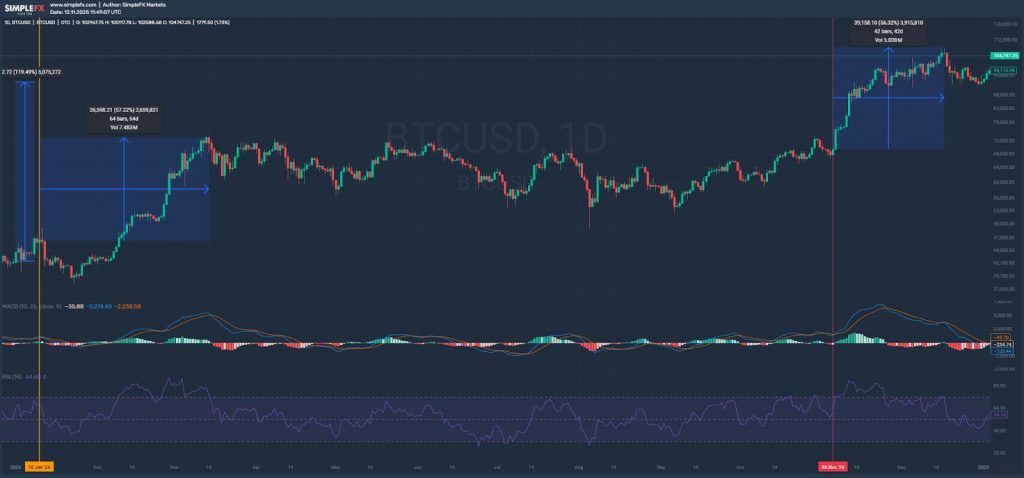
2024 is a 120% increase for BTC. We started the year below ~43,000 and closed at nearly $94,000. The gains were driven by two key events: the introduction of a spot BTC ETF and Donald Trump’s victory in the US presidential election. The former event caused the price to rise by 57% in just 2 months, and the latter by 57% in 1.5 months.
Satoshi: The smallest part of BTC
Because a single Bitcoin can be worth thousands of dollars, it needs to be divided into smaller units for everyday use. The smallest unit is a Satoshi, named after Bitcoin’s creator, Satoshi Nakamoto. One Bitcoin equals 100,000,000 Satoshis (0.00000001 BTC), allowing traders and investors to buy or trade even the tiniest fractions of BTC.
Bitcoin is a foundation of the crypto market – decentralized and transparent. From its 2008 whitepaper to its dominance today, it has become a benchmark for digital assets, combining innovation, security, and growing global adoption.